
Starting with this post, I will be going in a new direction with my blog over the next few weeks. Instead of sharing my journey, I shall be talking to other people and sharing their stories.
Each story will be different whether it’s a friend who’s gone through struggles, a person who raises money for mental health charities or someone who works for an organisation which supports those in need.
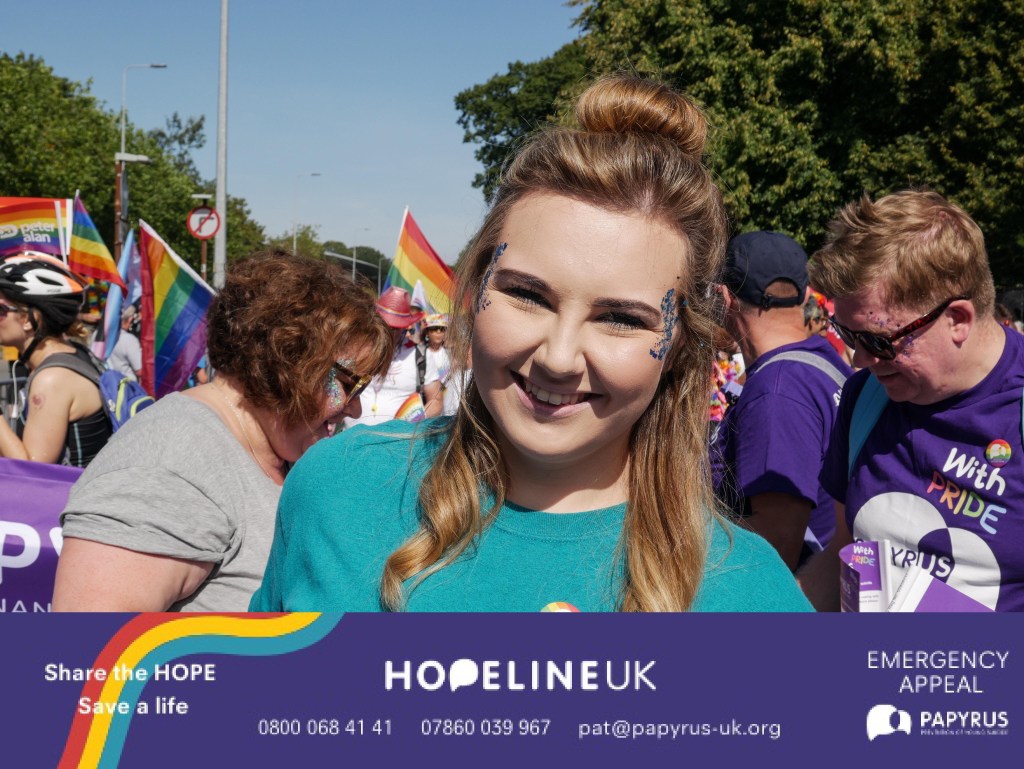
I shall begin with the lovely and fantastic Alicia Ewington. For nearly 3 years, Alicia has been working for PAPYRUS who are the national charity dedicated to the prevention of young suicide.
We chatted for nearly an hour, covering many great things PAPYRUS offers as an organisation, Alicia’s individual role, and she also opens up on some of her own personal experiences.
What is PAPYRUS and what is the mission that the organisation carries out?
PAPYRUS is the national charity dedicated to the prevention of suicide in young people. What we do as a charity is that we support, equip and influence. So we influence by informing the local and national suicide prevention strategies. We also release hard hitting campaigns which are based around the key issues experienced by young people with thoughts of suicide and those who are affected by it in any way.
We equip through training and workshops to communities and professionals. Through this we educate people on suicide prevention skills and how to be more aware of potential suicidal behaviour in young people. We provide support via our helpline, HOPELINEUK.
Our mission as a charity is to work towards shattering the stigma that surrounds suicide and we believe that the majority of young suicides can be prevented.
How does PAPYRUS carry out their mission and offer support to those in need?
We offer support via HOPELINEUK which is a suicide prevention helpline for any person up to the age of 35 who’re experiencing thoughts of suicide. We also support to those who have concerns for a young person. Concerned others include family members, loved ones, friends, carers, teachers or professionals.
If they have concerns and don’t know how to support that person or they’re concerned about a young person’s wellbeing and what they should do, they could give us a call and we’d provide confidential support and guidance.
More so for those aged 35 and under, we offer practical help and advice. For example, we offer a safety plan. So if someone does have suicidal thoughts and they’re really struggling to manage them, we’d offer a plan that gives the person some empowerment and would keep them safe. This can be offered for both a short and long term basis.
What is your role in PAPYRUS and what made you want to do this for a living?
My role with the organisation is a Suicide Prevention Adviser. I work on the helpline and also go out into the community and deliver workshops and training sessions.
Since leaving university, I’ve mostly had jobs where I’ve been in a supporting role and felt I could make a difference. I’ve worked in Children’s residential homes, young people’s supported accommodation and as a health adviser in the community. I also volunteered on an NHS trust mental health and well-being helpline.
Supporting others is important to me. When I found out about the job with PAPYRUS, I just went for it. To be honest, I wasn’t 100% sure of what the job role would entail when I went for it, I knew of course it was based around suicide prevention. But since I’ve started, I’ve never looked back and I’m always learning as time goes by. Suicide is everybody’s business and everyone can play a part in creating a suicide-safer community.
In what ways has working for the organisation helped you understand mental health in a better capacity?
Working in suicide prevention you understand that anyone can be affected by mental health and/or thoughts of suicide. Learning and becoming aware of the statistics can be an eye opener. 1 in 4 young people will experience some form of mental health issue (Young Minds) but this figure could be a lot higher.
In 2018, 1866 people aged 35 and under were reported to have died by suicide (ONS, 2018). But this could be a lot higher and there’s so much more that isn’t included in this figure. Some deaths may not be recorded as a suicide by the coroner, the intention of death may be unknown.
Previously, reporting a suicide was under the ‘burden of proof’ meaning the coroner has to be sure beyond all reasonable doubt that it the death was intended by suicide. This is now under the balance of probabilities and this change may show us an increase in suicide statistics in the future. This is a change that PAPYRUS worked hard to influence as it is important that we have an accurate representation of suicide as a community health concern.
Don’t forget these statistics don’t inform us of the many people who’re currently living with thoughts of suicide and people who’ve attempted and survived. Also those who’re bereaved by suicide. Suicide is the biggest killer of young people under 35. So my job has helped me understand all of those factors and the need for awareness and prevention.
How can people get in touch with PAPYRUS ?
Anyone who needs support and has thoughts of suicide can call, text or email HOPELINEUK (all contact details are posted at the end of the blog). The lines are open Monday to Friday 9am to 10pm. Weekends and bank holidays are 2pm to 10pm.
There’s also lots of resources and articles on our website such as leaflets which are created with young people in mind. The key themes and contributory factors that come through via our helpline help us create this literature. They are available in both English and Welsh as well as the website.
What do you wish was more well known about mental health?
It sounds cliché but I wish it was better known that it’s ok to not be ok. It’s something that’s said and seen a lot but is it really meant and taken on board? Everyone experiences ups and downs and talking about things makes it easier.
Even people who have struggled in the past and didn’t recognise that it may have been a mental health issue, it’s ok to talk about it now. It may have happened a while ago, but trauma is subjective and if it was a traumatic experience for you, it’s perfectly fine to be open about it whether it has been days, months or years down the line.
Anyone can experience post-traumatic stress. You don’t need to brush over it and pass it off. It does matter and talking about it will help instead of repressing it. It will help us move forward. That’s what I want people to know about mental health. It doesn’t matter how or when it happened, you can talk about it whenever you want.
Why do you think there is a stigma associated with mental health issues?
It’s a really good question because it’s one where you’d get a varied amount of answers. I think there’s a generational aspect. Times have changed over the years but also mental health wasn’t a known issue way back when. It wasn’t as openly talked about like it is today. Yet, there are so many changes for our young people today – the rise of social media means that young people are exposed to an adult world far sooner and are experiencing things that perhaps we as their elders don’t even understand.
I feel sometimes people don’t understand or want to understand things they haven’t experienced themselves. There are lots of stereotypes. The language used when we talk about mental health can be stigmatising like calling people ‘mental’, ‘crazy’, ‘psycho’ or ‘attention-seeking’.
We don’t always understand why someone is feeling the way they do and it can be frustrating, but that’s ok. We should just be kind and offer a helping hand or a listening ear.
Is there anything that you would like to share from a personal point of view regarding mental health?
I experienced a really difficult relationship breakdown. For years I was in a toxic relationship with an addict that was built on manipulation, gas-lighting and emotional abuse. So when that ended it was quite a traumatic experience for me.
I felt beaten and broken. I felt like I had lost all my independence. I felt really disconnected from myself, like I didn’t know who I was or what I liked and what brought me joy. Numb. Feeling like this left me constantly exhausted and like I didn’t have the energy to enjoy anything.
I had to deactivate my social media because I couldn’t bring myself to see other people happy; engagements, pregnancy announcements, new homes, marriages or nice holidays. I was subjecting myself to comparison that felt so much worse because of the situation I was in.
Over the years, I had been working so hard to try and ‘fix’ myself, paying for counselling sessions, asking for prescribed medication and I was never in a place where I was ready to engage with it as it was my environment that needed to change.
It took time to acknowledge that it was a tough time. I also realised it was a traumatic experience and it wasn’t going to pass overnight. But I allowed myself to feel and process my emotions and ultimately I’m here now and a lot happier than I was. I know that now I need to take more care of myself. If I’m not sleeping well, it can be due to some flashbacks of my experiences. I now know I need to do more productive things like walking or a work-out to feel more tired. So not only am I exercising my body, but also my mind
I think there is a stigma attached to anti-depressants or medication prescribed to help with mental health concerns. It’s a sigma I feel but I know that if I felt this was something I needed, I would try it. I encourage people to explore all avenues of support and medication is one of those avenues. People can be quick to judge and say things like “Are you sure you need to be on those?” or “Why are you taking anti-depressants?” but it’s a prescribed medication. It’s not like self-diagnosing and buying paracetamol over the counter.
From my own counselling sessions over the years, I’ve learned that our physical health and mental health come hand in hand. Looking after your physical health will in turn benefit your mental well-being. I like a website called youfeellikeshit.com where you get asked questions like “when was the last time you ate?” and if the answer isn’t appropriate, they tell you to have something to eat. It’s all based on self-care and empowering people to look after themselves better. When things feel overwhelming it can be really easy to forget to look after yourself and sometimes having a reminder to do something as simple as having a glass of water can make all the difference.
Of course, the whole Lockdown period has been tough for all of us. How have you been doing?
It’s been up and down or as what has been referred to as the “Corona-coaster”. Some days I have plenty of motivation where I get up early, go for a run, cook something and do some work. Then other days my alarm goes off and I can’t get myself out of bed. I ask myself “what’s the point?” because every day is the same.
The loss of a normal routine has a huge impact. I’m starting to slowly get back to normal as my office hours have increased and I’m spending more time in the Cardiff office. I’m finding it hard to readjust to be honest after being out of this routine for so long.
But of course this has been done to protect us and I know it’s not forever. I’ve spent the majority of it with my partner and its felt manageable as we have both been working. Things are starting to get back to normal – especially with the return of football.
To finish up, what would you say to someone who is struggling and doesn’t know if talking about it is the right thing to do?
I would say that talking about it is always the right things to do. It’s common for people to feel they don’t have anyone to talk to, fear that they will be judged or they will be burdensome. I can guarantee that most family or friends would be glad that you have opened up rather than bottled things up and suffered in silence.
If you don’t feel like you can talk to anyone around you then there are other options for support. I think there’s a bit of a stigma around contacting helplines but it’s a safe way to feel heard and get the support you deserve. Most helplines are confidential and anonymous – it’s a space to talk through what you are feeling and some support and advice if needed.
We’re quite specific at PAPYRUS in terms of supporting people with their suicidal thoughts. But there are other options such as the Samaritans, Saneline and depending on a person’s personal experiences there are so many other avenues of support.
Under the help and resources section on our website, there is a page that provides the details for so many other support services available in the UK.
I say to people that if you don’t feel like talking, reflect on things that haven’t worked or things you haven’t tried. It’s ok to take your time and it’s ok to ask for what you need.
I’d also encourage family and friends to be aware also. If you’ve noticed any changes in someone, just ask them if they’re ok. Noticing and asking can be a huge relief for someone who is struggling to ask for help.
At the end of the day, there is hope and there is help.
As you can see from my chat with Alicia, PAPYRUS offer an incredible amount of support and education regarding suicide prevention. She also went into detail about some of her own individual battles which shows how strong of a person she is. It proves to show that no matter what avenue you choose, whether it’s counselling or medication, there is a road back and being open is key.
I’m very glad that Alicia is in a much better place. She’s in a relationship, in a job she loves and feels she can make a difference and although like many of us, has good and bad days, she knows there’s better ways of coping and recognising these clouds are only temporary.
As promised, there are some links and information for PAPYRUS. If you ever need to contact them, please do so. They give fantastic support and have a dedicated team 7 days a week who offers guidance through your most difficult time.
Massive thanks again to Alicia and PAPYRUS. Of course a thank you goes to all of you so for reading this. There will be more of these interviews to come over the next few weeks covering a whole range of topics.
For now please stay safe, take care and I’ll see you later!
WEBSITE: papyrus-uk.org
CALL: 0800 068 41 41
TEXT: 07860 039967
EMAIL: pat@papyrus-uk.org
 MIND OVER NOISE